


AI · Workflow automation
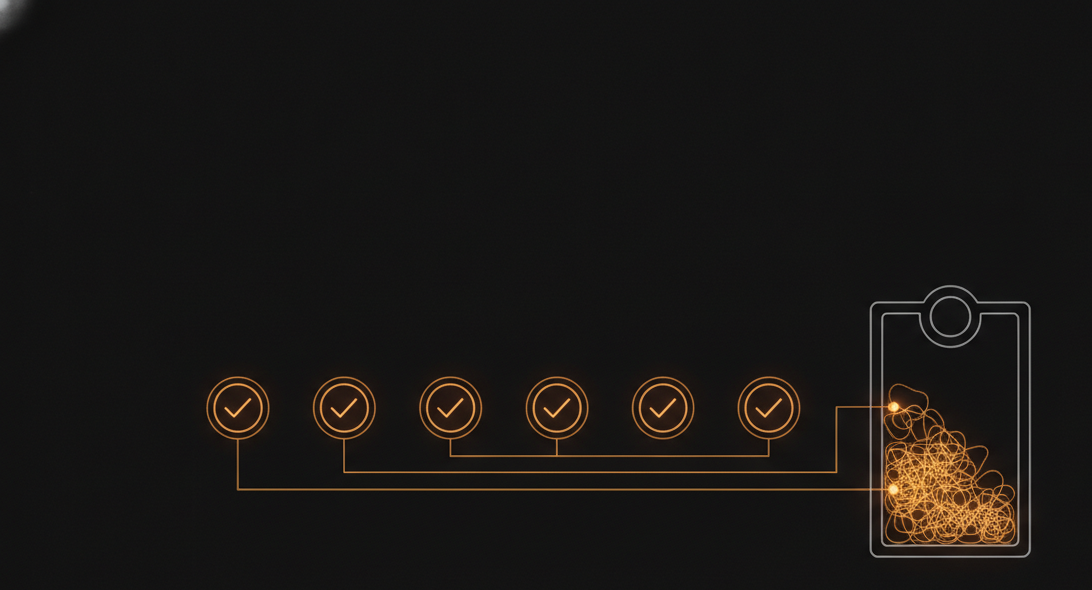
Your automation handles the clicks. Every step that needs a judgment call still lands in someone's inbox.
Banao builds AI workflow automation that runs a whole business process end to end — reading the unstructured inputs, making the routing and approval decisions a rule engine can't express, calling your systems to act, and escalating only the genuine exceptions to a person. It's the orchestration layer over the tools you already run, not another brittle bot bolted to a screen.
We build it the way we run our own 300-person company: every process mapped before it's automated, every decision logged and replayable, hardened in our own operation before it touches yours.
Banao — Vikaas— our own demand-gen process runs as an AI workflow, decisions and all, every working day.
The first call is free · 45 minutes · no obligation
What we build
What goes into an end-to-end automated workflow
An automated process is not a single bot. It is a discovery pass, an orchestration engine, the AI decision steps, the system integrations, and the exception handling that decides who finishes a case — we own all of it.
Process discovery and mapping
We measure where a process actually spends its time and leaks errors before automating a thing — because the step that feels slow is rarely the step that costs the most.
Workflow orchestration
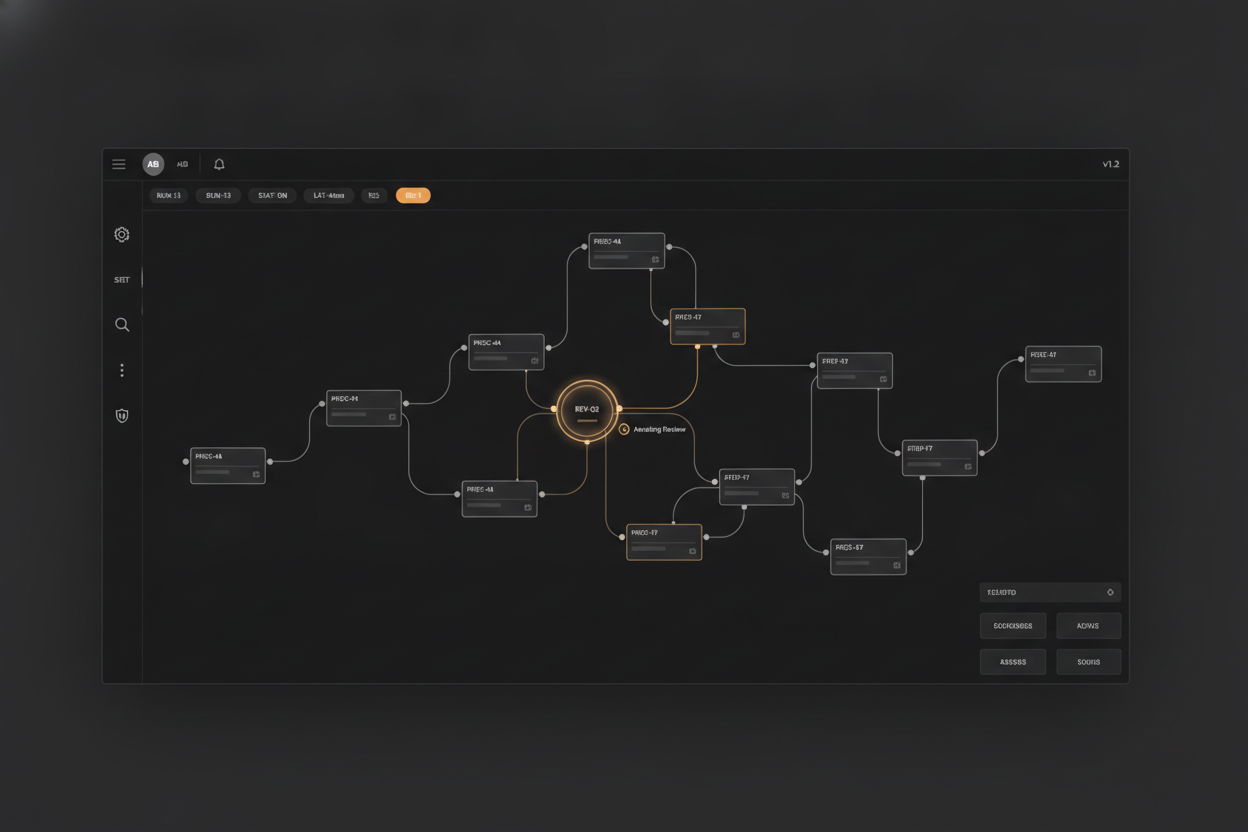
An engine that sequences steps across your systems and holds the state of every in-flight case, so a process can pause, retry, and resume instead of dropping work when one step fails.
AI decision steps
Classify, extract, score, route — the judgment a rule tree can't capture, each step scoped to one decision and grounded in your data rather than the model's guesswork.
Intelligent document and input handling
Turn emails, scanned PDFs, forms, and free-text notes into structured data the workflow can act on — the unstructured inputs where rule-based automation stops dead.
System and API integration
Function calls wired to your CRM, ERP, ticketing, and databases, including older systems via retrofit, so the workflow acts on real records instead of describing what it would do.
RPA and AI together
Keep the deterministic screen-driving where your bots already work; add a model only on the steps that need reading or deciding, and wire the two into one process.
Exception handling and human-in-the-loop
Route the genuine edge cases to a person with full context, run the rest straight through, and design the hand-over so a human reviews a decision rather than chasing a raw error.
Straight-through processing
Design for the cases that should never touch a human and put the gate exactly where one should — high-volume processing that finishes on its own, with a clear line for the rest.
Monitoring, audit, and governance
Every decision logged with its inputs, reasoning, and action so any case can be replayed, plus SLA and drift alerts that flag a workflow before it quietly degrades.
Continuous improvement
Cycle time, exception rate, and cost per case measured from the first case and tuned on live data — so improvement is a number you can see, not a claim we make.
Where RPA stops and AI workflow automation starts
Classic RPA is a recording of clicks. It logs into a screen, copies a field, pastes it somewhere else, and repeats — fast, cheap, and completely literal. It is the right tool when a process is stable, structured, and rule-bound, and it has earned its place in thousands of back offices. What it cannot do is make a decision. The moment a step requires reading an unstructured email, judging whether two records are the same customer, or choosing which of five approval paths a case belongs on, the bot stops and a person takes over.
AI workflow automation is built around exactly those steps. It owns the whole process end to end — the deterministic parts handled by plain code or your existing bots, the judgment parts handled by a model that classifies, extracts, scores, and routes. The orchestration engine holds the state of every in-flight case, decides what happens next, calls the systems that need to act, and pulls in a person only for the exceptions that truly need one. The result is a process that finishes on its own far more often, instead of stalling at the first step a rule could not express.
RPA does the clicks, AI does the calls
Keep the deterministic screen-driving where it already works. Add a model only on the steps that need reading, classifying, or deciding — then wire the two into one process with a single owner.
Unstructured input is the dividing line
If the input is a clean row in a table, rules win. If it is an email, a scanned PDF, a free-text note, or a photo, that is where AI workflow automation earns its place.
The exception is the product
A good automated workflow is judged by how few cases it has to escalate and how well it hands over the ones it does — with full context, not a raw stack trace.
How we actually build an end-to-end automated workflow
We do not start by automating. We start by mapping where a process spends its time and where it leaks errors, because the step that feels slow is rarely the step that costs the most. Often a third of the work disappears once the real bottleneck is named — before any model is involved.
From there we build in layers. The orchestration engine and the system integrations come first, so the workflow can move a case through your real tools and hold its state if a step fails at 3 a.m. Then we add the AI decision steps — document extraction, classification, routing — each one scoped, grounded in your data, and wrapped in a check that catches a low-confidence call before it acts. A human gate sits on the consequential decisions until the numbers say the workflow has earned more autonomy.
Map before you automate
Two weeks of process discovery tells us which steps to automate, which to delete, and which to leave to people — so we are not paving a cow path at machine speed.
Integration is the foundation, not the afterthought
The workflow has to act on your CRM, ERP, and ticketing through their APIs, including legacy systems via retrofit. We build that surface first; the AI sits on top of it.
Confidence thresholds, not blind action
Every AI decision carries a confidence score. Above the line it runs straight through; below it, the case routes to a person — so the workflow is right far more often than it is fast-and-wrong.
Instrumented from the first case
Cycle time, exception rate, and cost per case are measured from case one, so widening autonomy is a decision backed by numbers rather than a leap of faith.
Why most workflow-automation projects stall halfway
We get called in to finish a lot of automation that started well and stopped at sixty percent. The pattern is consistent, and none of it is about the model. It is about automating the wrong thing, or automating a process that was never stable enough to automate.
We would rather name these on the first call than bill you to find them on the third. If your last automation effort plateaued, it almost certainly hit one of the following.
Automating chaos
Point automation at a broken process and you get faster chaos. If the process is not yet stable and understood, that is the work to do first — automating it only multiplies the mess.
No plan for the exceptions
Teams automate the happy path, declare a win, and find that the 20% of edge cases generate 80% of the support load. Exception handling is the design, not a follow-up ticket.
A bot per task, no owner for the process
Ten disconnected bots are not an automated workflow. Without an orchestration layer that owns the end-to-end case, every hand-off between bots is a fresh place to break.
No measurement, no trust
If no one can see cycle time and exception rate, no one widens the workflow's autonomy. Instrumentation is how adoption happens — a team trusts what it can watch.
Receipts
Automated workflows already doing real work
Metrics shown dotted (··) are being finalised in our case-study metrics pack — published only once verified. The deployments are live.
Demand generation run as an end-to-end AI workflow
Vikaas plans, drafts, sequences, and routes Banao's own demand generation as an automated workflow, with a person approving what goes out. We run our revenue engine on it before we offer the pattern to a client.
Back-office onboarding moved to straight-through processing
An onboarding workflow reads the incoming documents, validates them against the systems of record, sets up the accounts, and escalates only the cases that fail a check — so the team handles exceptions instead of keying in the routine ones.
AI and automation systems delivered into a national-scale operation
Long-running delivery of AI and automation work into a national operations environment, built to hold up under the volume and governance a critical-infrastructure operator runs to.
Dogfooding
We run our own company on the workflows we sell
Banao operates a ~300-person engineering company on its own AI workflow automation before any client sees it. Vikaas runs our demand generation as an automated process; InterviewGod runs our hiring. Both move real cases through real systems, every working day, with our own team handling the exceptions.
That is the difference between a vendor who has read about automation and one who depends on it to run a business. When a workflow has to survive our own operation, the version that reaches yours is already hardened.
Runs Banao's own demand-gen process end to end — drafting, sequencing, and routing, with a person on the gate.
Runs Banao's own screening workflow before a recruiter opens the pile.
Where we deliver
Where we build and run automated workflows
We deliver from offices in India, the UAE, the UK, and the US, and we build each workflow to the data-residency and governance rules its market expects.
GCC & UAE
From Dubai we automate back-office and operations work across the free zones and the wider GCC, including manufacturing operations with RAK Ceramics. Workflows are built to keep case data inside UAE boundaries where the PDPL and client policy require it.
Saudi Arabia
Vision 2030 and the giga-projects are pushing shared-services and operations teams to automate faster than manual hiring can match. We build Arabic-capable document and decision steps and keep case data in-Kingdom to meet PDPL and SDAIA expectations for regulated work.
United States
For California and New York enterprises, rising labour costs and reshoring make straight-through processing of finance, insurance, and back-office work a board-level priority. We build to SOC 2 controls with the audit logging procurement and risk teams now expect of any automated decision.
United Kingdom
Our Cambridge UK presence supports enterprise and public-sector process automation under UK GDPR and ICO guidance, where an automated decision has to be explainable and a named person has to stay accountable for it.
India
Bangalore and Chandigarh hold our delivery bench, so a build starts in weeks. We automate high-volume operations close to the engineering that ships them, designed to the DPDP Act and run cost-efficiently.
The honest version
When workflow automation is the wrong call
Most vendors will automate anything you point them at. We would rather tell you when not to — it is why technical and operations teams take our second call.
- A stable, fully rule-based process: if every step is deterministic and the inputs are clean, plain RPA or a script is cheaper and more reliable than adding a model to it.
- A process that isn't stable yet: if the steps still change week to week, standardise the process first — automating a moving target wastes the build.
- Low volume: if a task runs a handful of times a week, a person is cheaper than designing, governing, and operating an automated workflow for it.
- No system to act on: if the tools a workflow needs have no API or stable interface, the first project is integration, not automation.
- Decisions that can't tolerate a wrong call with no human gate: if an error can't be caught and reversed, keep a person on that step rather than running it straight through.
How we start
How we start — map it before you automate it
You have likely been pitched automation tools already. We start by proving which steps of your process should be automated, which should be deleted, and which belong to people — not by quoting a build.
- 01
AI Discovery Sprint
2 weeks · fixed price
We map your candidate process, measure where the time and errors go, test feasibility on the hardest step, and hand back a scoped automation design, an exception plan, and an ROI model built on your real volumes and cost per case — yours to keep either way. If you proceed, the Sprint cost is credited against the build.
- 02
Build
We build the orchestration engine, the system integrations, the AI decision steps, and the exception handling together — integration and governance are deliverables, not afterthoughts.
- 03
Production and continuous improvement
We deploy behind approval gates with full logging and monitoring, widen straight-through processing only as the numbers allow, and keep cutting cycle time and exception rate on live cases.
FAQ
Frequently asked questions
What is AI workflow automation?
It is automating a whole business process end to end, not a single task. An orchestration engine moves each case through your systems, AI handles the steps that need judgment — reading a document, classifying a request, deciding a route — and a person is pulled in only for the exceptions. The aim is a process that finishes on its own far more often than it stalls.
How is AI workflow automation different from RPA?
RPA mimics clicks on a fixed screen and is ideal for stable, rule-based steps, but it can't make a decision or read unstructured input. AI workflow automation adds that decision layer — and usually keeps your RPA bots for the deterministic parts. You don't pick one; the workflow uses each where it is strongest.
Do we have to rip out our existing RPA bots?
No, and you usually shouldn't. Bots that reliably drive a stable screen are doing their job. We orchestrate them inside a larger workflow and add AI only where a bot hits a step that needs reading or deciding. The investment you have already made keeps working.
Which processes are the best candidates to automate?
High volume, lots of manual reading or routing, and a painful exception rate — invoice and claims processing, customer and employee onboarding, KYC, order and case management. If your team spends its day moving information between systems and making the same routine judgment calls, that is the target.
How do you handle exceptions and edge cases?
Exceptions are the centre of the design, not an afterthought. Every AI decision carries a confidence score; above the threshold it runs straight through, below it the case routes to a person with full context. We measure the exception rate from day one and drive it down as the workflow earns trust.
How do you keep automated decisions auditable and compliant?
Every decision the workflow makes is logged with its inputs, the model's reasoning, and the action taken, so any case can be replayed. For regulated work we keep data in your required region, build to SOC 2 or UK GDPR controls, and keep a named person accountable for consequential decisions.
How long until a workflow is in production?
A common path is a 2-week Discovery Sprint, a 6–10 week build of the first end-to-end workflow, and a staged rollout that starts behind approval gates. Our ~300-engineer bench means delivery begins in weeks, not the months a fresh hire would take.
How do we prove ROI before committing budget?
That is what the AI Discovery Sprint produces — fixed price, two weeks, a mapped process, a scoped automation design, and an ROI model built on your real volumes and cost per case, yours to keep whether or not you continue.
Will it integrate with the systems we already run?
Yes — that is the point of a workflow. We wire it to SAP, Salesforce, your ERP, ticketing, and databases through their APIs, including older systems via retrofit. Integration is part of the build deliverable, not a separate project.
Can it run in our own cloud or data region?
Yes. We deploy to your cloud and keep case data inside the region your policy or regulation requires — UAE, Saudi Arabia, UK, US, or India — with the audit logging your risk team needs to sign off.
Get started
Find the process that's costing you the most — and automate the right part of it
Bring the workflow that eats the most hours or throws the most exceptions. In 45 minutes we'll tell you which steps to automate, which to leave to people, and what it takes to run it end to end in production.
Book a Discovery Sprint